
- Home /
- Industries /
- Cement & Construction Materials
- Industries · Cement & Construction
Cement & Construction Materials
The cement manufacturing process is material-handling intensive. A typical integrated cement plant moves raw materials — limestone, clay, iron ore corrections, gypsum — through crushing, raw grinding, preheater and kiln systems, clinker cooling, and finish grinding, before dispatching cement in bulk or bagged form.
Key bulk materials handled within a cement plant include: raw meal (kiln feed), coal and petcoke for kiln firing, clinker, fly ash as a supplementary cementitious material, gypsum, and finished cement. Each stage demands reliable, dust-controlled, and continuous material transfer — often across significant distances within the plant footprint.
Cement plants also routinely receive bulk materials via road bulker (fly ash, gypsum, slag), rail wagon, and in coastal facilities, by ship. Outbound dispatch occurs via road bulker or rail to ready-mix concrete plants, precast units, and construction projects.
- Operational Challenges
Four critical material handling challenges in cement plants.
Understanding these operational pain points drives SaveEco’s system design philosophy — every solution starts with a site audit, not a product catalogue.
01
ESP Hopper & Bag Filter Dust Evacuation
Cement plants operate multiple emission control points — kiln ESPs, raw mill bag filters, cement mill bag filters, cooler ESPs. Reliable and continuous dust evacuation from these hoppers using dense phase conveying systems prevents bypass and unplanned shutdowns.
02
Inter-Silo Cement Transfer
Moving cement between storage silos to packing plants, bulk loading stations, or dispatch points requires enclosed pneumatic conveying to prevent dust generation and product loss. Lean phase and dense phase systems each have application-specific advantages.
03
Road Bulker and Rail Wagon Unloading
Plants receiving fly ash, gypsum, or slag via road bulker or rail wagon must handle high-volume inbound transfers with minimal turnaround time. Pneumatic unloading systems with air fluidisation technology significantly reduce vehicle detention time.
04
Dust at Transfer Points & Silo Tops
Open belt conveyor transfer points, silo filling points, and packer feed systems are common dust generation sources. Air pollution control systems integrated with conveying infrastructure control fugitive emissions and support environmental compliance.
- Engineering Solution
SaveEco Engineering Solutions for Cement Plants
SaveEco’s system portfolio covers the full range of cement plant material handling requirements — from inbound raw material reception through in-plant transfer to outbound dispatch.
01 Dense Phase Conveying — ESP and Kiln Dust TransfeR
SaveEco Series (Master-Slave) Vessel Conveying systems handle fine cement kiln dust and ESP hoppers efficiently. The system collects from multiple hopper sources simultaneously and conveys to a central silo or disposal point at low velocity, preventing particle degradation and pipe wear. Operating pressure up to 3.5 bar, the conveying system is suited to kiln dust characteristics — high temperature, fine particle size, and variable bulk density.
02 Twin (Tandem) Vessel Dense Phase — Cement & Raw Meal
For continuous high-tonnage transfer of cement between silos or from silo to loading bay, SaveEco’s Twin Tandem Vessel system operates in alternating pressurisation cycles to maintain near-continuous material flow. Capacities from 100 TPH to 500 TPH over distances up to 1.6 km make it suitable for large integrated cement plants.
03 Road Bulker Receiving and Dispatch Systems
SaveEco road bulker systems with volumetric capacities of 30 m³, 50 m³, and 70 m³ support fly ash and supplementary material inbound logistics. Operating at 2 bar with a targeted unloading time of approximately 30 minutes, these systems reduce vehicle waiting time and keep plant supply chains moving. Outbound cement dispatch uses the same pneumatic conveying infrastructure integrated with weighbridge and truck loading facilities.
04 Rail Wagon Systems — Fly Ash & Bulk Material Reception
For plants receiving fly ash from power stations by rail, SaveEco offers semi-automated and fully automated rail wagon unloading stations. The 60 m³ wagon system operates at 2 bar with air fluidisation technology, conveying material to storage silos or directly into process.
05 Silo Engineering and Jumbo Bag Unloading
Silo design, aeration systems, and anti-arching devices are provided as part of complete system packages. Jumbo bag (FIBC) and small bag unloading stations handle additives such as grinding aids, specialty minerals, and micro-dosing chemicals with integrated dust collection.
- Typical Plant Applications
Eight proven application points across the cement plant lifecycle.
These are the most common application points where SaveEco systems are deployed in integrated cement plants. Each has been proven across multiple installations in India and internationally.
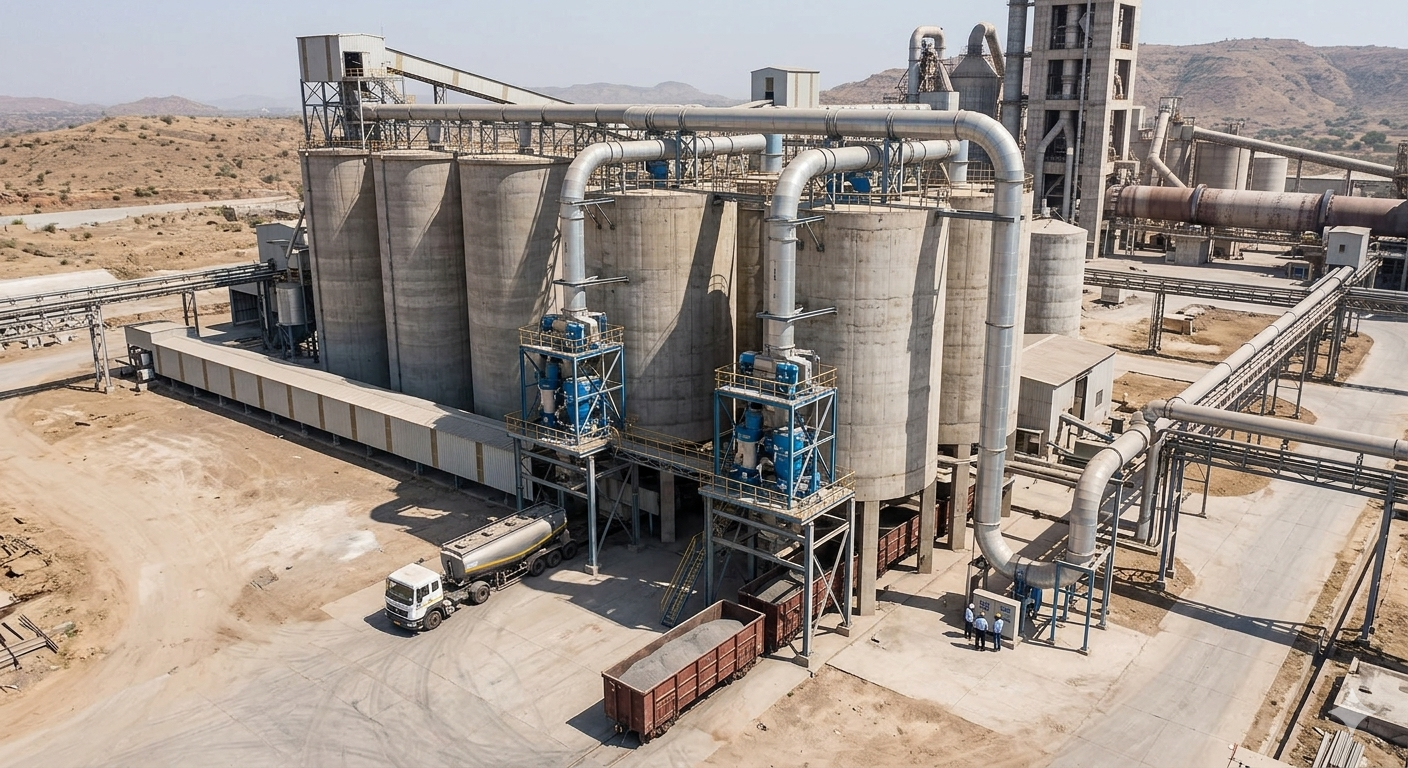
- Clinker storage silo feeding via air slide and pneumatic conveying
- Cement silo to truck loading point (road bulker dispatch)
- Fly ash reception from road bulker or rail wagon to storage
- Cement packer feed from silo via dense phase or lean phase systems
- Cement powder transfer from mill outlet to storage silos
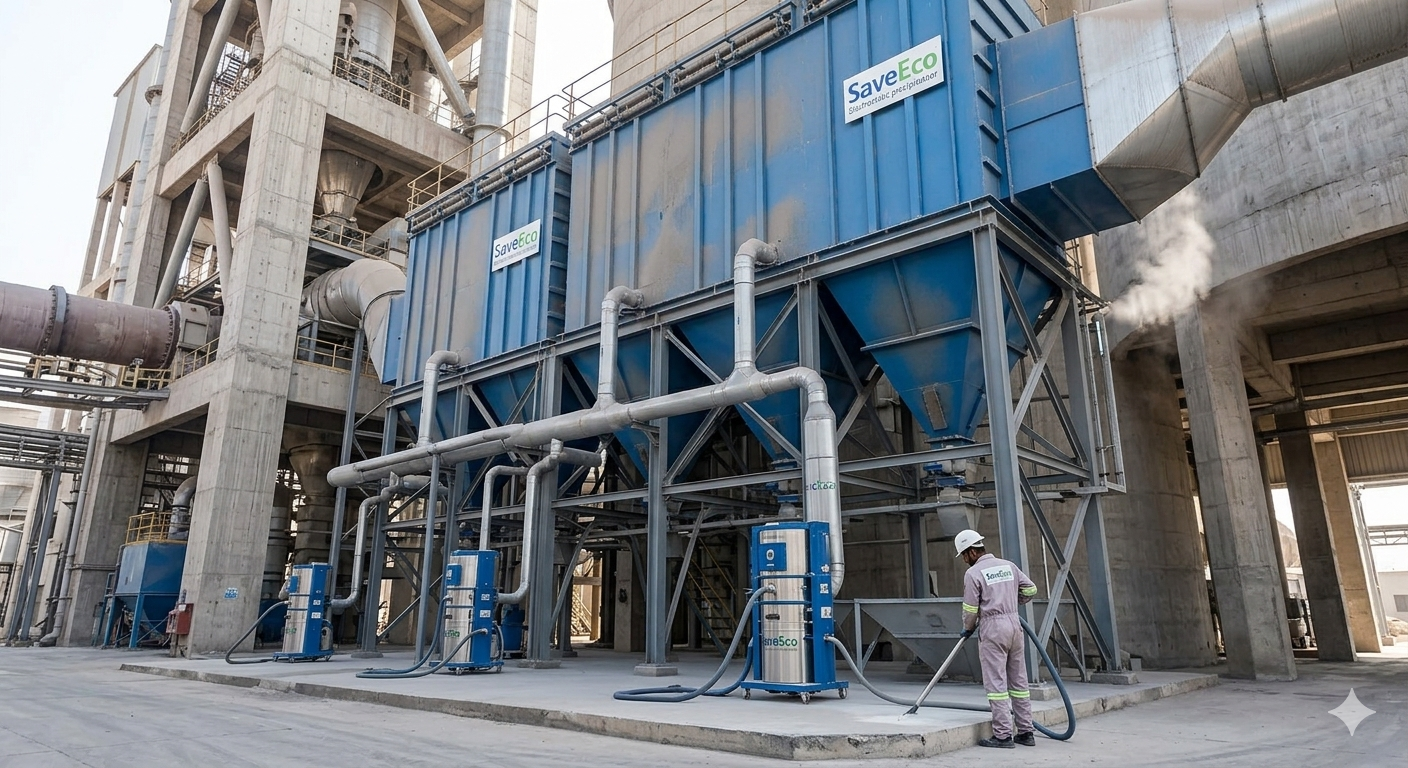
- ESP hopper dust collection and conveying to disposal silo
- Gypsum and slag inbound handling and silo feeding
- Plant housekeeping — centralised vacuum systems for bag filter areas
- Why SaveEco for Cement
Operational Benefits
Enclosed Conveying
Enclosed conveying eliminates cement and dust spillage at transfer points — supporting regulatory compliance and plant cleanliness.
Reduced Pipe Wear
Dense phase low-velocity conveying reduces pipe wear for abrasive materials — significantly extending system service life and reducing maintenance costs.
Automated Vessel Cycling
Automated vessel cycling maintains plant throughput without manual intervention — reducing operator dependency and improving system availability.
Multi-Modal Receiving
Supports flexible raw material logistics — handling road, rail, and sea inbound streams through unified infrastructure.
Environmental Compliance
Integrated dust collection maintains CPCB compliance at filling and discharge points.
Modular System Design
Phased implementation aligned with plant expansion — protecting capital investment while enabling future growth.
- Start Your Industrial Consultation
Discuss Your Cement Plant Requirement
Contact SaveEco’s engineering team with your plant layout, material specifications, and throughput requirements. We respond with a technical proposal — not a product catalogue.